ノイズモデルを構築する
パッケージのバージョン
このページのコードは、以下の要件を使用して開発されました。 これらのバージョン以降の使用を推奨します。
qiskit[all]~=2.5.2
qiskit-ibm-runtime~=0.47.0
qiskit-aer~=0.17
このページでは、Qiskit Aer の noise モジュールを使用して、エラーが存在する環境での量子回路シミュレーション用ノイズモデルを構築する方法を説明します。これは、ノイズのある量子プロセッサをエミュレートしたり、量子アルゴリズムの実行におけるノイズの影響を研究したりする際に役立ちます。
# Added by doQumentation — installs the packages this notebook needs if they are missing
import importlib.util

_needed = {"numpy": "numpy", "qiskit": "qiskit", "qiskit_aer": "qiskit-aer", "qiskit_ibm_runtime": "qiskit-ibm-runtime"}
_missing = [pip for module, pip in _needed.items()
            if importlib.util.find_spec(module) is None]
# One at a time, so a package that fails to install does not block the others
for _pip in _missing:
    %pip install -q {_pip}
if not _missing:
    print("\u2713 All required packages are installed")
import numpy as np
from qiskit import QuantumCircuit
from qiskit.quantum_info import Kraus, SuperOp
from qiskit.visualization import plot_histogram
from qiskit.transpiler import generate_preset_pass_manager
from qiskit_aer import AerSimulator

# Import from Qiskit Aer noise module
from qiskit_aer.noise import (
    NoiseModel,
    QuantumError,
    ReadoutError,
    depolarizing_error,
    pauli_error,
    thermal_relaxation_error,
)
Qiskit Aer の noise モジュール
Qiskit Aer の noise モジュールには、シミュレーション用のカスタマイズされたノイズモデルを構築するための Python クラスが含まれています。主要なクラスは3つあります:
-
NoiseModelクラス — ノイズシミュレーションに使用するノイズモデルを格納します。 -
QuantumErrorクラス — CPTP ゲートエラーを記述します。適用できるタイミングは以下のとおりです:-
ゲートまたはリセット命令の後
-
測定命令の前
-
-
ReadoutErrorクラス — 古典的な読み出しエラーを記述します。
バックエンドからノイズモデルを初期化する
物理バックエンドの最新のキャリブレーションデータからパラメーターを設定して、ノイズモデルを初期化できます。
これらの例では qiskit_ibm_runtime の FakeSherbrooke モックバックエンドを使用していますが、Qiskit 互換の実際のバックエンドやフェイクバックエンドで試すこともできます。
from qiskit_ibm_runtime.fake_provider import FakeSherbrooke

backend = FakeSherbrooke()
noise_model = NoiseModel.from_backend(backend)
これにより、そのバックエンドを使用したときに発生するエラーをおおまかに近似したノイズモデルが得られます。ノイズモデルのパラメーターをより詳細に制御したい場合は、このページの残りの部分で説明するように、独自のノイズモデルを作成する必要があります。
量子エラー
QuantumError オブジェクトを直接扱う代わりに、特定のタイプのパラメーター化された量子エラーを自動的に生成するヘルパー関数が多数用意されています。これらは noise モジュールに含まれており、量子コンピューティング研究でよく使用される多くのエラータイプの関数が含まれています。関数名とそれが返すエラーのタイプは以下のとおりです:
| 標準エラー関数 | 詳細 |
|---|---|
kraus_error | クラウス行列のリスト として与えられる一般的な n-Qubit CPTP エラーチャネル。 |
mixed_unitary_error | ユニタリ行列と確率のリスト として与えられる n-Qubit 混合ユニタリエラー。 |
coherent_unitary_error | 単一のユニタリ行列 として与えられる n-Qubit コヒーレントユニタリエラー。 |
pauli_error | パウリ演算子と確率のリスト として与えられる n-Qubit パウリエラーチャネル(混合ユニタリ)。 |
depolarizing_error | 脱分極確率 でパラメーター化された n-Qubit 脱分極エラーチャネル。 |
reset_error | 、 状態へのリセット確率 でパラメーター化された単一 qubit リセットエラー。 |
thermal_relaxation_error | 緩和時定数 、、ゲート時間 、励起状態の熱的占有率 でパラメーター化された単一 qubit 熱緩和チャネル。 |
phase_amplitude_damping_error | 振幅減衰パラメーター 、位相減衰パラメーター 、励起状態の熱的占有率 によって与えられる単一 qubit の一般化された位相・振幅減衰エラーチャネル。 |
amplitude_damping_error | 振幅減衰パラメーター と励起状態の熱的占有率 によって与えられる単一 qubit の一般化された振幅減衰エラーチャネル。 |
phase_damping_error | 位相減衰パラメーター によって与えられる単一 qubit の位相減衰エラーチャネル。 |
量子エラーの結合
QuantumError インスタンスは、合成、テンソル積、テンソル展開(逆順テンソル積)を使用して組み合わせることで、新しい QuantumErrors を生成できます。
-
合成: →
error = error1.compose(error2) -
テンソル積: →
error = error1.tensor(error2) -
展開積: →
error = error1.expand(error2)
例
5% の確率で発生する単一 qubit のビットフリップエラーを構築するには:
# Construct a 1-qubit bit-flip and phase-flip errors
p_error = 0.05
bit_flip = pauli_error([("X", p_error), ("I", 1 - p_error)])
phase_flip = pauli_error([("Z", p_error), ("I", 1 - p_error)])
print(bit_flip)
print(phase_flip)
QuantumError on 1 qubits. Noise circuits:
  P(0) = 0.05, Circuit =
   ┌───┐
q: ┤ X ├
   └───┘
  P(1) = 0.95, Circuit =
   ┌───┐
q: ┤ I ├
   └───┘
QuantumError on 1 qubits. Noise circuits:
  P(0) = 0.05, Circuit =
   ┌───┐
q: ┤ Z ├
   └───┘
  P(1) = 0.95, Circuit =
   ┌───┐
q: ┤ I ├
   └───┘
# Compose two bit-flip and phase-flip errors
bitphase_flip = bit_flip.compose(phase_flip)
print(bitphase_flip)
QuantumError on 1 qubits. Noise circuits:
  P(0) = 0.0025000000000000005, Circuit =
   ┌───┐┌───┐
q: ┤ X ├┤ Z ├
   └───┘└───┘
  P(1) = 0.0475, Circuit =
   ┌───┐┌───┐
q: ┤ X ├┤ I ├
   └───┘└───┘
  P(2) = 0.0475, Circuit =
   ┌───┐┌───┐
q: ┤ I ├┤ Z ├
   └───┘└───┘
  P(3) = 0.9025, Circuit =
   ┌───┐┌───┐
q: ┤ I ├┤ I ├
   └───┘└───┘
# Tensor product two bit-flip and phase-flip errors with
# bit-flip on qubit-0, phase-flip on qubit-1
error2 = phase_flip.tensor(bit_flip)
print(error2)
QuantumError on 2 qubits. Noise circuits:
  P(0) = 0.0025000000000000005, Circuit =
     ┌───┐
q_0: ┤ X ├
     ├───┤
q_1: ┤ Z ├
     └───┘
  P(1) = 0.0475, Circuit =
     ┌───┐
q_0: ┤ I ├
     ├───┤
q_1: ┤ Z ├
     └───┘
  P(2) = 0.0475, Circuit =
     ┌───┐
q_0: ┤ X ├
     ├───┤
q_1: ┤ I ├
     └───┘
  P(3) = 0.9025, Circuit =
     ┌───┐
q_0: ┤ I ├
     ├───┤
q_1: ┤ I ├
     └───┘
QuantumChannel 演算子との相互変換
Qiskit Aer の QuantumError オブジェクトと Qiskit の QuantumChannel オブジェクトとの間で相互変換を行うこともできます。
# Convert to Kraus operator
bit_flip_kraus = Kraus(bit_flip)
print(bit_flip_kraus)
Kraus([[[-9.74679434e-01+1.19363805e-16j,
          0.00000000e+00+0.00000000e+00j],
        [ 0.00000000e+00+0.00000000e+00j,
         -9.74679434e-01+0.00000000e+00j]],

       [[ 0.00000000e+00+0.00000000e+00j,
          4.69834045e-18-2.23606798e-01j],
        [-2.26855945e-17-2.23606798e-01j,
          5.03721386e-33+4.96506831e-17j]]],
      input_dims=(2,), output_dims=(2,))
# Convert to Superoperator
phase_flip_sop = SuperOp(phase_flip)
print(phase_flip_sop)
SuperOp([[1. +0.j, 0. +0.j, 0. +0.j, 0. +0.j],
         [0. +0.j, 0.9+0.j, 0. +0.j, 0. +0.j],
         [0. +0.j, 0. +0.j, 0.9+0.j, 0. +0.j],
         [0. +0.j, 0. +0.j, 0. +0.j, 1. +0.j]],
        input_dims=(2,), output_dims=(2,))
# Convert back to a quantum error
print(QuantumError(bit_flip_kraus))

# Check conversion is equivalent to original error
QuantumError(bit_flip_kraus) == bit_flip
QuantumError on 1 qubits. Noise circuits:
  P(0) = 1.0, Circuit =
   ┌───────┐
q: ┤ kraus ├
   └───────┘
True
読み出しエラー
古典的な読み出しエラーは、割り当て確率ベクトル のリストによって指定されます:
-
は記録された古典ビット値です
-
は測定から返された真のビット値です
例えば、1つの qubit の場合:。
# Measurement misassignment probabilities
p0given1 = 0.1
p1given0 = 0.05

ReadoutError([[1 - p1given0, p1given0], [p0given1, 1 - p0given1]])
ReadoutError([[0.95 0.05]
 [0.1  0.9 ]])
読み出しエラーも、量子エラーと同様に compose、tensor、expand を使用して結合できます。
ノイズモデルへのエラーの追加
量子エラーをノイズモデルに追加する際には、適用する命令の種類と、適用する qubit を指定する必要があります。量子エラーには2つのケースがあります:
-
全 qubit 量子エラー
-
特定 qubit 量子エラー
1. 全 qubit 量子エラー
これは、どの qubit に作用するかに関係なく、命令が出現するたびに同じエラーを適用します。
noise_model.add_all_qubit_quantum_error(error, instructions) として追加します:
# Create an empty noise model
noise_model = NoiseModel()

# Add depolarizing error to all single qubit u1, u2, u3 gates
error = depolarizing_error(0.05, 1)
noise_model.add_all_qubit_quantum_error(error, ["u1", "u2", "u3"])

# Print noise model info
print(noise_model)
NoiseModel:
  Basis gates: ['cx', 'id', 'rz', 'sx', 'u1', 'u2', 'u3']
  Instructions with noise: ['u2', 'u3', 'u1']
  All-qubits errors: ['u1', 'u2', 'u3']
2. 特定 qubit 量子エラー
これは、指定された qubit のリストに作用する命令が出現するたびにエラーを適用します。qubit の順序が重要であることに注意してください。例えば、2 qubit ゲートに対して qubit [0, 1] に適用されるエラーは、qubit [1, 0] に適用されるエラーとは異なります。
noise_model.add_quantum_error(error, instructions, qubits) として追加します:
# Create an empty noise model
noise_model = NoiseModel()

# Add depolarizing error to all single qubit u1, u2, u3 gates on qubit 0 only
error = depolarizing_error(0.05, 1)
noise_model.add_quantum_error(error, ["u1", "u2", "u3"], [0])

# Print noise model info
print(noise_model)
NoiseModel:
  Basis gates: ['cx', 'id', 'rz', 'sx', 'u1', 'u2', 'u3']
  Instructions with noise: ['u2', 'u3', 'u1']
  Qubits with noise: [0]
  Specific qubit errors: [('u1', (0,)), ('u2', (0,)), ('u3', (0,))]
非局所 qubit 量子エラーに関する注意
NoiseModel は非局所 qubit 量子エラーの追加をサポートしていません。これらは NoiseModel の外部で処理する必要があります。独自の条件で量子エラーを回路に挿入する必要がある場合は、独自のトランスパイラーパスを作成(TransformationPass)し、シミュレーターを実行する直前にそのパスを実行することを推奨します。
ノイズモデルを使用したノイズシミュレーションの実行
AerSimulator(noise_model=noise_model) コマンドは、指定されたノイズモデルに設定されたシミュレーターを返します。シミュレーターのノイズモデルを設定するだけでなく、ノイズモデルのゲートに応じてシミュレーターのベーシスゲートも上書きされます。
ノイズモデルの例
ここでは、いくつかのノイズモデルの例を紹介します。デモには、n-Qubit GHZ 状態を生成する簡単なテスト回路を使用します:
# System Specification
n_qubits = 4
circ = QuantumCircuit(n_qubits)

# Test Circuit
circ.h(0)
for qubit in range(n_qubits - 1):
    circ.cx(qubit, qubit + 1)
circ.measure_all()
print(circ)
┌───┐                ░ ┌─┐
   q_0: ┤ H ├──■─────────────░─┤M├─────────
        └───┘┌─┴─┐           ░ └╥┘┌─┐
   q_1: ─────┤ X ├──■────────░──╫─┤M├──────
             └───┘┌─┴─┐      ░  ║ └╥┘┌─┐
   q_2: ──────────┤ X ├──■───░──╫──╫─┤M├───
                  └───┘┌─┴─┐ ░  ║  ║ └╥┘┌─┐
   q_3: ───────────────┤ X ├─░──╫──╫──╫─┤M├
                       └───┘ ░  ║  ║  ║ └╥┘
meas: 4/════════════════════════╩══╩══╩══╩═
                                0  1  2  3
理想的なシミュレーション
# Ideal simulator and execution
sim_ideal = AerSimulator()
result_ideal = sim_ideal.run(circ).result()
plot_histogram(result_ideal.get_counts(0))

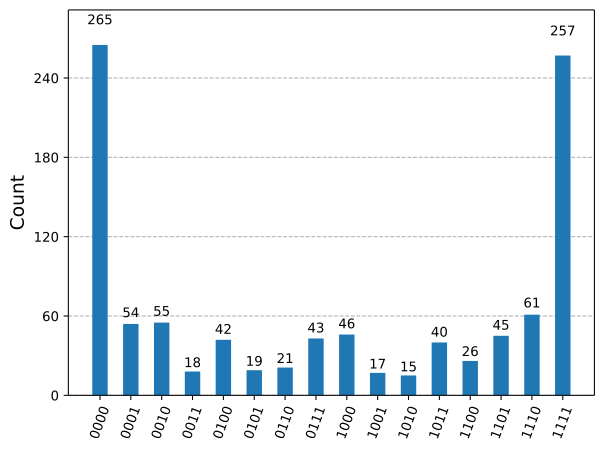
ノイズ例1:基本的なビットフリップエラーノイズモデル
量子情報理論研究でよく使われる簡単なノイズモデルの例を考えてみましょう:
-
単一 qubit ゲートを適用するとき、確率
p_gate1で qubit の状態を反転させます。 -
2 qubit ゲートを適用するとき、各 qubit に単一 qubit エラーを適用します。
-
qubit をリセットするとき、確率
p_resetで 0 の代わりに 1 にリセットします。 -
qubit を測定するとき、確率
p_measで qubit の状態を反転させます。
# Example error probabilities
p_reset = 0.03
p_meas = 0.1
p_gate1 = 0.05

# QuantumError objects
error_reset = pauli_error([("X", p_reset), ("I", 1 - p_reset)])
error_meas = pauli_error([("X", p_meas), ("I", 1 - p_meas)])
error_gate1 = pauli_error([("X", p_gate1), ("I", 1 - p_gate1)])
error_gate2 = error_gate1.tensor(error_gate1)

# Add errors to noise model
noise_bit_flip = NoiseModel()
noise_bit_flip.add_all_qubit_quantum_error(error_reset, "reset")
noise_bit_flip.add_all_qubit_quantum_error(error_meas, "measure")
noise_bit_flip.add_all_qubit_quantum_error(error_gate1, ["u1", "u2", "u3"])
noise_bit_flip.add_all_qubit_quantum_error(error_gate2, ["cx"])

print(noise_bit_flip)
NoiseModel:
  Basis gates: ['cx', 'id', 'rz', 'sx', 'u1', 'u2', 'u3']
  Instructions with noise: ['u2', 'u1', 'reset', 'cx', 'measure', 'u3']
  All-qubits errors: ['reset', 'measure', 'u1', 'u2', 'u3', 'cx']
ノイズシミュレーションの実行
# Create noisy simulator backend
sim_noise = AerSimulator(noise_model=noise_bit_flip)

# Transpile circuit for noisy basis gates
passmanager = generate_preset_pass_manager(
    optimization_level=3, backend=sim_noise
)
circ_tnoise = passmanager.run(circ)

# Run and get counts
result_bit_flip = sim_noise.run(circ_tnoise).result()
counts_bit_flip = result_bit_flip.get_counts(0)

# Plot noisy output
plot_histogram(counts_bit_flip)
例2:T1/T2 熱緩和
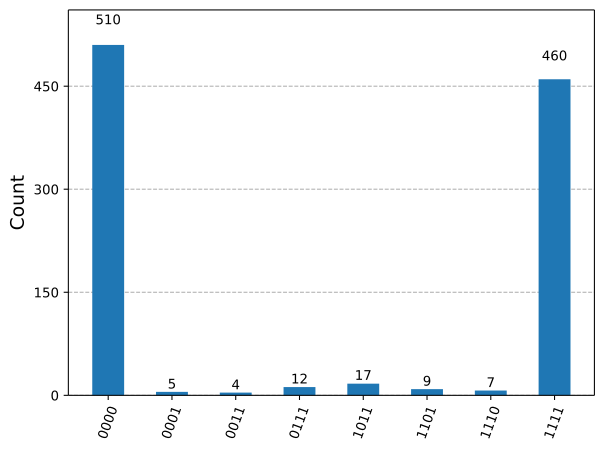
次に、qubit 環境との熱緩和に基づいた、より現実的なエラーモデルを考えてみましょう:
- 各 qubit は、熱緩和時定数 と位相緩和時定数 でパラメーター化されます。
- でなければならないことに注意してください。
- 命令のエラー率は、ゲート時間と qubit の 、 の値によって決まります。
# T1 and T2 values for qubits 0-3
T1s = np.random.normal(
    50e3, 10e3, 4
)  # Sampled from normal distribution mean 50 microsec
T2s = np.random.normal(
    70e3, 10e3, 4
)  # Sampled from normal distribution mean 50 microsec

# Truncate random T2s <= T1s
T2s = np.array([min(T2s[j], 2 * T1s[j]) for j in range(4)])

# Instruction times (in nanoseconds)
time_u1 = 0  # virtual gate
time_u2 = 50  # (single X90 pulse)
time_u3 = 100  # (two X90 pulses)
time_cx = 300
time_reset = 1000  # 1 microsecond
time_measure = 1000  # 1 microsecond

# QuantumError objects
errors_reset = [
    thermal_relaxation_error(t1, t2, time_reset) for t1, t2 in zip(T1s, T2s)
]
errors_measure = [
    thermal_relaxation_error(t1, t2, time_measure) for t1, t2 in zip(T1s, T2s)
]
errors_u1 = [
    thermal_relaxation_error(t1, t2, time_u1) for t1, t2 in zip(T1s, T2s)
]
errors_u2 = [
    thermal_relaxation_error(t1, t2, time_u2) for t1, t2 in zip(T1s, T2s)
]
errors_u3 = [
    thermal_relaxation_error(t1, t2, time_u3) for t1, t2 in zip(T1s, T2s)
]
errors_cx = [
    [
        thermal_relaxation_error(t1a, t2a, time_cx).expand(
            thermal_relaxation_error(t1b, t2b, time_cx)
        )
        for t1a, t2a in zip(T1s, T2s)
    ]
    for t1b, t2b in zip(T1s, T2s)
]

# Add errors to noise model
noise_thermal = NoiseModel()
for j in range(4):
    noise_thermal.add_quantum_error(errors_reset[j], "reset", [j])
    noise_thermal.add_quantum_error(errors_measure[j], "measure", [j])
    noise_thermal.add_quantum_error(errors_u1[j], "u1", [j])
    noise_thermal.add_quantum_error(errors_u2[j], "u2", [j])
    noise_thermal.add_quantum_error(errors_u3[j], "u3", [j])
    for k in range(4):
        noise_thermal.add_quantum_error(errors_cx[j][k], "cx", [j, k])

print(noise_thermal)
NoiseModel:
  Basis gates: ['cx', 'id', 'rz', 'sx', 'u2', 'u3']
  Instructions with noise: ['u2', 'reset', 'cx', 'measure', 'u3']
  Qubits with noise: [0, 1, 2, 3]
  Specific qubit errors: [('reset', (0,)), ('reset', (1,)), ('reset', (2,)), ('reset', (3,)), ('measure', (0,)), ('measure', (1,)), ('measure', (2,)), ('measure', (3,)), ('u2', (0,)), ('u2', (1,)), ('u2', (2,)), ('u2', (3,)), ('u3', (0,)), ('u3', (1,)), ('u3', (2,)), ('u3', (3,)), ('cx', (0, 0)), ('cx', (0, 1)), ('cx', (0, 2)), ('cx', (0, 3)), ('cx', (1, 0)), ('cx', (1, 1)), ('cx', (1, 2)), ('cx', (1, 3)), ('cx', (2, 0)), ('cx', (2, 1)), ('cx', (2, 2)), ('cx', (2, 3)), ('cx', (3, 0)), ('cx', (3, 1)), ('cx', (3, 2)), ('cx', (3, 3))]
ノイズシミュレーションの実行
# Run the noisy simulation
sim_thermal = AerSimulator(noise_model=noise_thermal)

# Transpile circuit for noisy basis gates
passmanager = generate_preset_pass_manager(
    optimization_level=3, backend=sim_thermal
)
circ_tthermal = passmanager.run(circ)

# Run and get counts
result_thermal = sim_thermal.run(circ_tthermal).result()
counts_thermal = result_thermal.get_counts(0)

# Plot noisy output
plot_histogram(counts_thermal)
次のステップ
- ノイズのある回路をシミュレートするには、Qiskit Aer プリミティブを使用した厳密・ノイズシミュレーションを参照してください。
- Qiskit Aer ノイズモジュールのリファレンスを確認してください。